A LIVING COAST · FOOD & LIVELIHOODS

How Middle Bank supports food security.

Before seafood reaches a kitchen or market, it depends on life in the water. Middle Bank is a shallow coastal ecosystem in the Penang Strait, off the eastern shore of Penang Island. Its habitats and fishing grounds connect marine life to people’s food and livelihoods. Keeping those connections healthy matters alongside fair access, affordable food and responsible fisheries management.

Follow the connection

A plain-language guide · Explore at your own pace

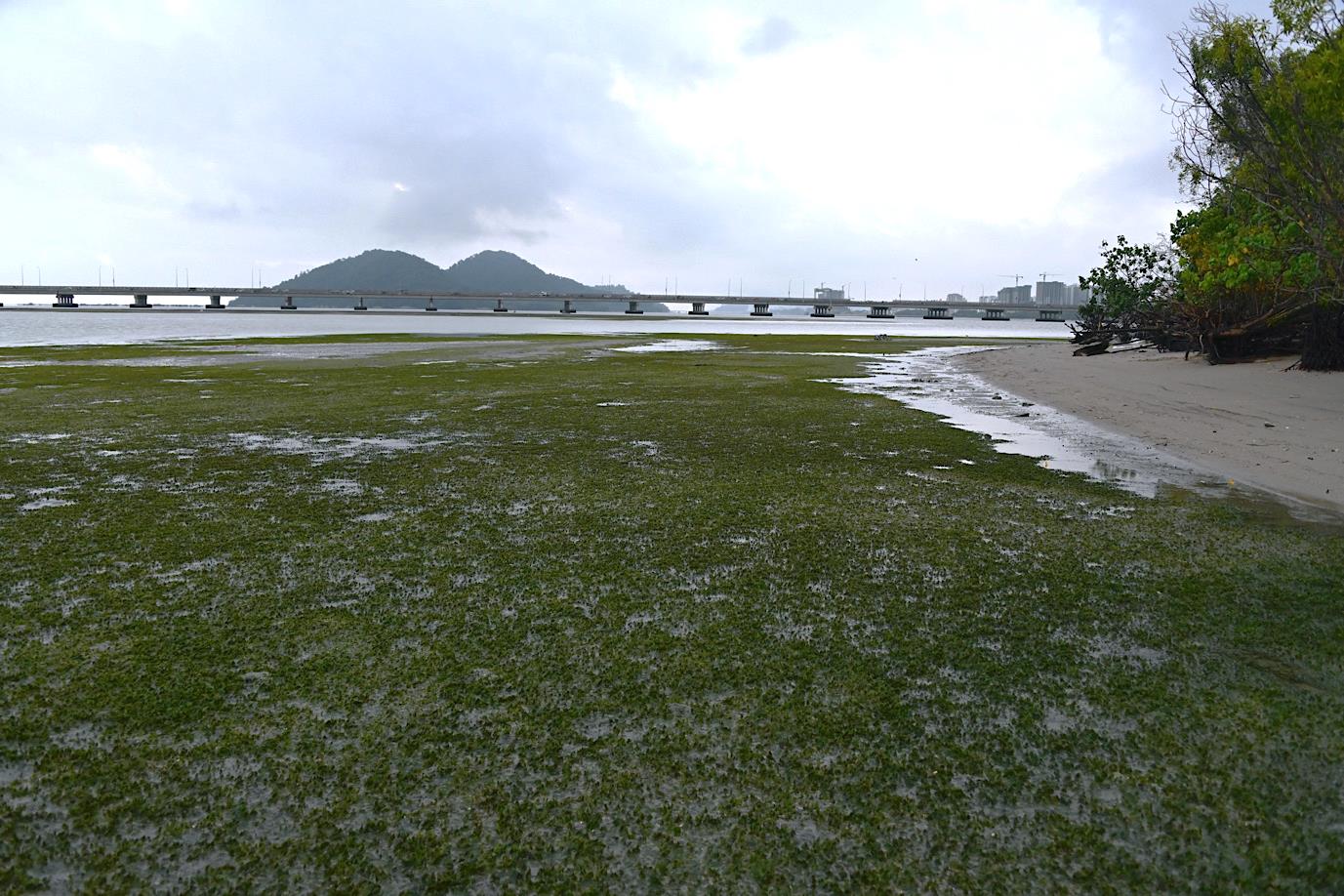
Green Halophila seagrass exposed around Pulau Gazumbo at low tide, with the first Penang Bridge in the distance.Open full-size image
Halophila communities around Pulau Gazumbo at low tide. Source: 2023 Middle Bank report, p. 12.Penang Institute / CEMACS · 2023 · p. 12 ↗

A report photograph of the Halophila meadow at low tide. It illustrates habitat, rather than today’s measured condition or a particular seafood supply chain.

A healthy coast can help support fisheries. Food security also depends on whether people can obtain, afford and benefit from food over time.

EXPLORE THE CONNECTION

From seagrass to food security.

Explore how a living coast can connect to food and livelihoods. Start with habitats, follow marine life and fishing, then explore two possible routes to household food access.

FROM SEA TO TABLE

Living habitats. Fishing livelihoods. Family meals.

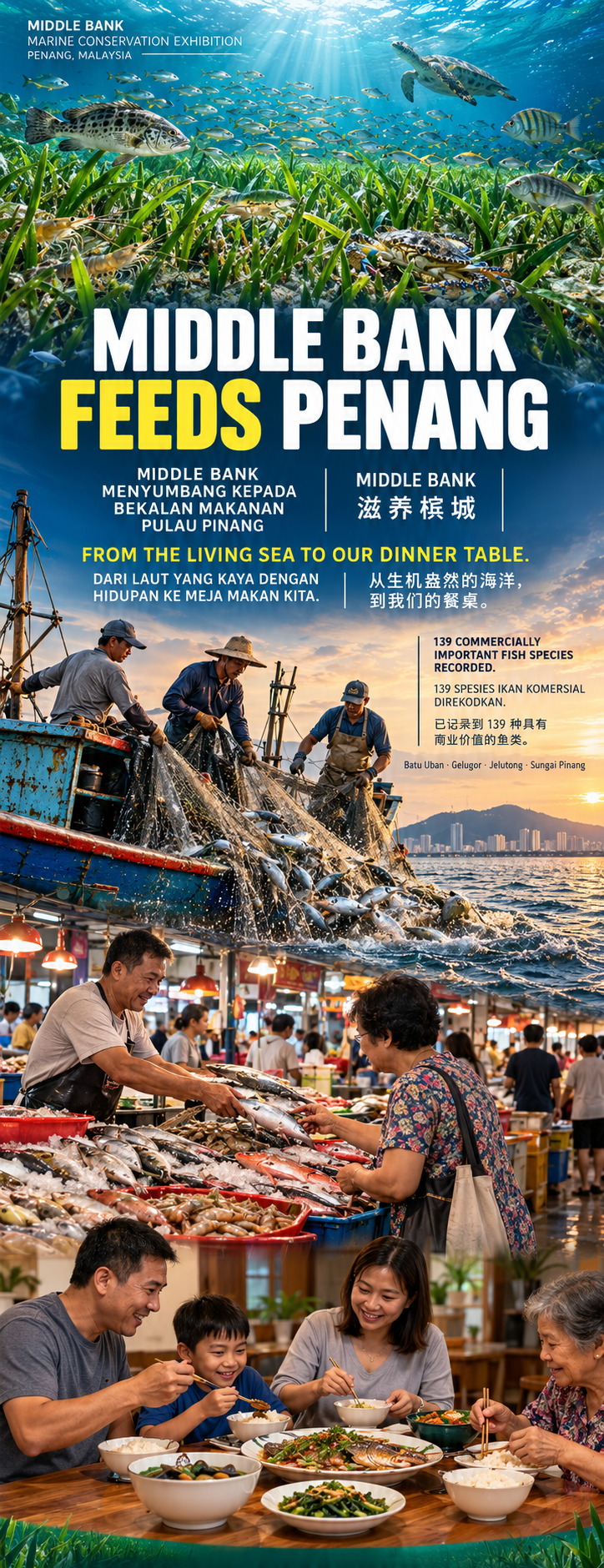
This illustration follows a connection from marine habitats to fishing, seafood markets and the household table.

  1. A living food web

    Seagrass meadows and nearby habitats form part of a wider food web.

  2. Fishing and markets

    Fishers and seafood traders connect marine resources with livelihoods and markets.

  3. Food reaches households

    What people can eat also depends on income, prices, access, handling and household choices.

The artwork’s “139” refers to the 2023 report’s commercial-fish inventory entries. It is not a catch-volume estimate or a measure of how much of Penang’s seafood comes from Middle Bank. 2023 report · source and scope ↗

AI-generated poster headed “Middle Bank feeds Penang”, with Malay and Chinese text. It shows seagrass and marine animals, fishers hauling a net, a seafood market and a family sharing a meal.Open full-size image
Image credit: AIAI-generated illustration; the fishing, market and family scenes are imagined. This image does not trace the origin of an actual meal.

Select a numbered connection, or take the guided tour. Each explanation includes its evidence and limits.

Middle Bank · Penang StraitA conceptual coastal illustration
  1. Coastal habitatsLocal record
  2. Marine lifeWider science
  3. FishingLocal record
  4. Food kept to eatIllustrative route
  5. Catch sold for incomeIllustrative route
  6. Household food accessFAO framework
Read the evidenceLocal recordWider scienceIllustrative routeFAO framework

Two illustrative routes: food kept to eat, or catch sold to earn income. Their relative importance at Middle Bank needs local study.

The lines show relationships, not measured flows, equal effects or the journey of a particular fish. Illustrations and animal numbers are symbolic. This is not a map, a measurement of current condition or a forecast.

01 · Local record

Habitats

The local report describes seagrass alongside mudflats, mollusc beds and permanently submerged waters. Different spaces support different organisms.

Why this matters to peoplePlaces used by marine life are part of the foundation of fishing grounds.

What this does and does not show

The bank is a connected habitat mosaic. A habitat description alone does not measure its contribution to adult catches.

02 · Wider science

Marine life

Seagrass can offer shelter and places to feed. Algae, small animals and decomposing material provide several food-web pathways; many fish benefit by eating prey rather than grass.

Why this matters to peopleShelter and feeding opportunities can support animals that fisheries use. Contributions differ between species and places.

What this does and does not show

Broader research explains these mechanisms. Benefits vary by species and life stage; not every young fish reaches an adult fishery.

03 · Local record

Fishing

The report records artisanal fishing and low-tide shellfish gathering around Middle Bank. Fishing connects habitats to the people using these waters.

Why this matters to peopleFishing and shellfish gathering connect the coast with people’s work, knowledge and livelihoods.

What this does and does not show

Reported activities establish a local connection, not today’s catch volume. Fishing effort, gear, access and fish populations also shape catches.

04 · Illustrative route

Food kept to eat

In small-scale fisheries, some catch may be kept for household meals rather than sold. This is one possible route from fishing to food access.

Why this matters to peopleFood retained from a catch can contribute directly to a household’s diet.

What this does and does not show

An illustrative livelihood route, not a measured share of Middle Bank catches or proof of a particular household’s diet.

05 · Illustrative route

Catch sold for income

Selling catch can provide income to buy food and other essentials. Handling, processing and trading also connect people to fisheries livelihoods.

Why this matters to peopleFishing income can help people buy food. Costs, prices and access affect what that income can provide.

What this does and does not show

An illustrative route based on wider guidance. The sources do not measure Middle Bank household earnings, costs or spending on food.

06 · FAO framework

Households

Food reaches people through both supplies and purchasing power. A productive fishing ground is one contributor; affordable markets, fair access and suitable food matter too.

Why this matters to peopleSeafood supply matters alongside people’s ability to obtain suitable food, benefit from it and rely on access over time.

What this does and does not show

More fish in a habitat does not automatically mean better nutrition or lower prices for every household.

MORE THAN FOOD SUPPLY

Four questions about food.

Food security means being able to get enough suitable, nutritious food reliably. FAO’s conventional framework asks us to look at four connected dimensions.

Availability

Is food available?

Habitats help support fisheries. Other production, stocks and trade also influence supply.

Access

Can people obtain and afford it?

Income, prices, markets, transport and access rights affect who can get food.

Utilisation

Can food nourish people?

Diet, preparation, handling and health affect how people benefit from food.

Stability

Can people rely on it?

Supply and access need to last through seasons, environmental pressures and economic shocks.

THE COAST IS ALSO A WORKPLACE

Fishing knowledge. Everyday livelihoods.

The 2023 report identifies fishers from Batu Uban, Gelugor, Jelutong and Sungai Pinang, describing nets, long lines (rawai) and crab pots (bubu). It also records shellfish collection, sometimes for local sale. These are documented uses, rather than a survey of current household diets or earnings.

Illustrative livelihood routes, not measured shares of Middle Bank catches. Their importance depends on household choices, costs, rights and market conditions.

FAO guidance also recognises post-harvest workers, including women in processing and trade. Their knowledge and working conditions belong in fisheries decisions; this is wider guidance, not a local employment estimate.

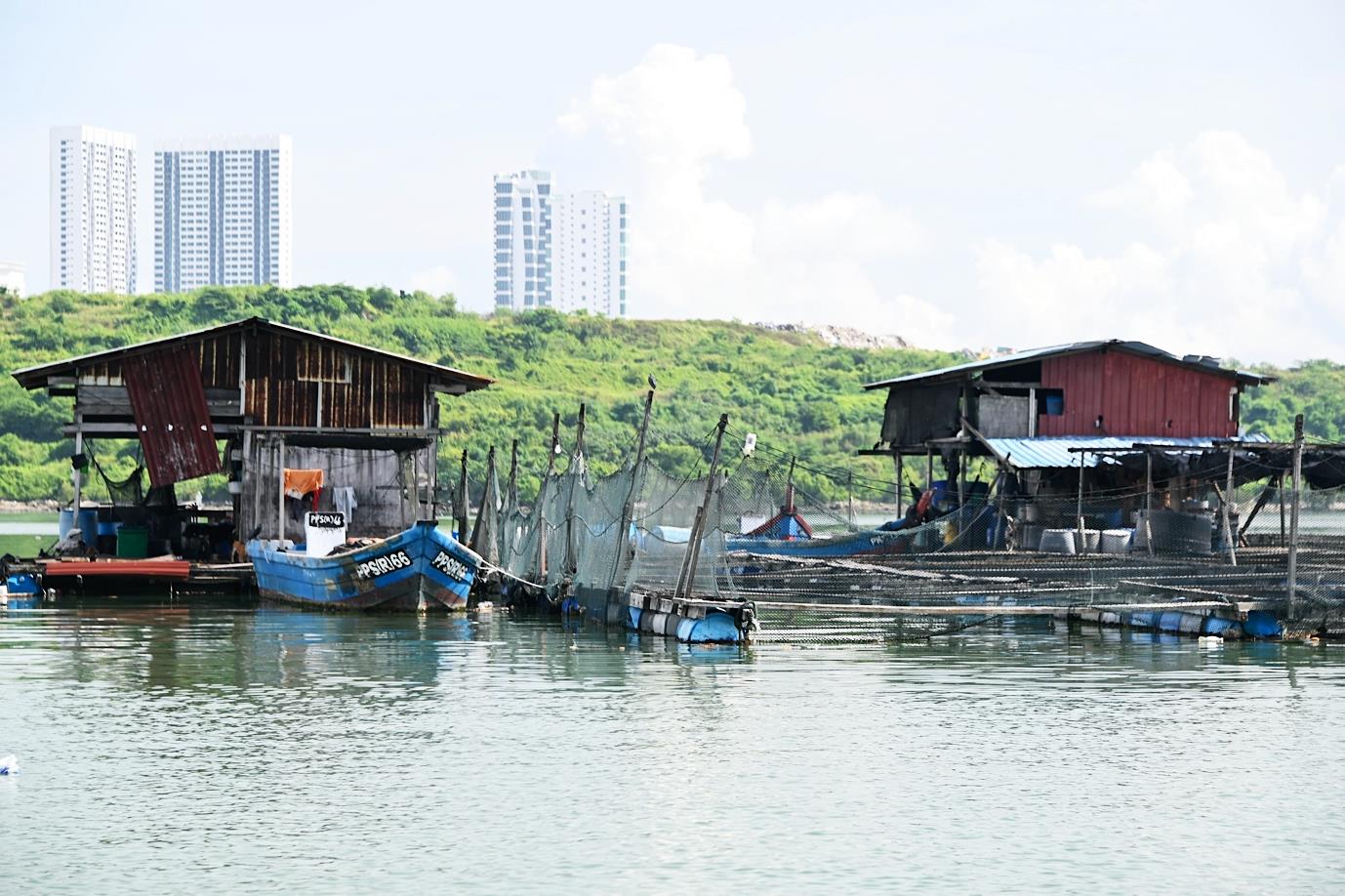
Floating aquaculture cages, small boats and wooden shelters near the Jelutong coastline. Open full-size image
Aquaculture cages near the Jelutong coastline. Source: 2023 Middle Bank report, p. 15.Penang Institute / CEMACS · Report page 15 ↗Open full-size image ↓

SEAFOOD AND ITS CONNECTIONS

Coastal habitats. Food and livelihoods.

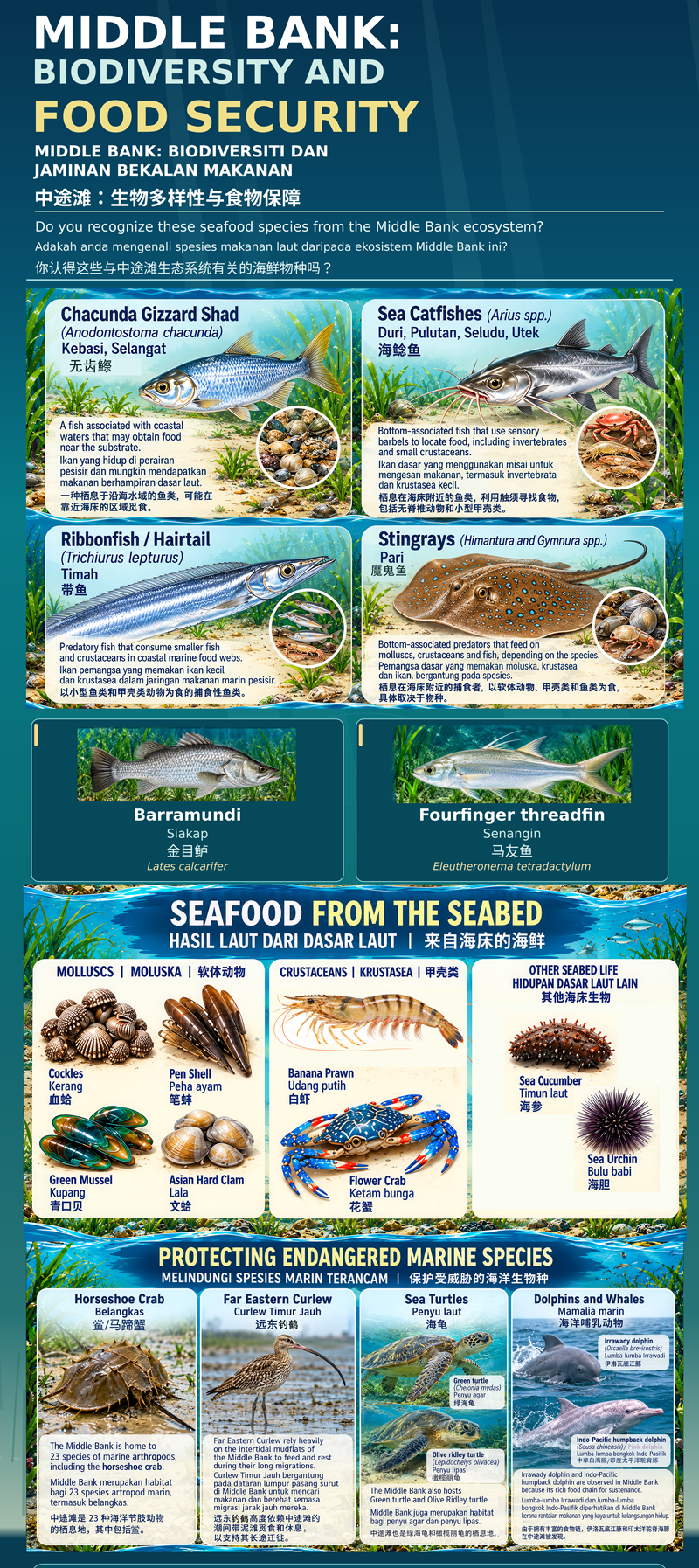
Fish, shellfish and crustaceans connect coastal habitats with fishing, meals and household income. This illustration brings seafood examples and conservation species into one visual guide.

Read it alongside the source-linked inventory and the food-system pathways on this page. The animals shown are illustrative; the image does not establish where a catch came from or whether it is safe to eat.

AI-generated trilingual infographic titled “Middle Bank: Biodiversity and Food Security”, showing fish, molluscs, prawns and crabs, with a separate conservation panel for horseshoe crabs, a curlew, turtles, dolphins and whales.Open full-size image
Image credit: AIAI-generated illustration; not a field photograph or catch record. The conservation species shown are not presented as seafood.

WHEN THE CONNECTIONS ARE UNDER PRESSURE

What could change along the pathway?

Choose a pressure to explore a possible sequence and a useful response. These are qualitative explanations, not measured losses or forecasts for Middle Bank.

Explore a possible pressure

Less light in the water

  1. Ecological change

    Suspended sediment can reduce the light reaching seagrass; deposition can affect plants and their habitat.

  2. Possible fisheries connection

    If habitat condition declines, shelter or feeding opportunities may change. The size of any effect on adult catches remains uncertain.

  3. People and a useful response

    Monitor light, sediment and meadow condition alongside fishing records. Test assumptions before treating a mitigation measure as successful.

What would we need to measure? Do sediment changes coincide with persistent habitat change, and how do affected species and fishing effort respond?

Loss or disturbance of habitat

  1. Ecological change

    Physical damage or habitat removal can reduce or fragment places used by plants and animals.

  2. Possible fisheries connection

    Some fish or invertebrates may lose feeding or nursery habitat. Other habitats and life stages also influence their populations.

  3. People and a useful response

    Avoid preventable damage and assess connected habitats. Involve fishers in understanding where and when important activities occur.

What would we need to measure? Which habitats are affected, which animals use them, and do changes affect recruitment or catches after accounting for fishing effort?

Environmental and seasonal stress

  1. Ecological change

    Heat and other environmental pressures can affect seagrass condition; responses depend on intensity, duration and local conditions.

  2. Possible fisheries connection

    Changes in habitat support can add to uncertainty already faced by fisheries. A local catch effect cannot be calculated from a global study.

  3. People and a useful response

    Combine environmental monitoring with seasonal fishing and household information. Plan for reliable food access as well as habitat condition.

What would we need to measure? How do meadow condition, weather, fishing opportunities and household food access vary through seasons and stressful periods?

Where the EIA is referenced, this page uses the version made publicly available on 12 February 2025 during the feedback period. Its predictions are conditional; they are not observed damage or proof of current approval.

Examine the development evidence

PROTECT HABITATS · INCLUDE PEOPLE

Protection needs fair, practical management.

Protecting habitats can help maintain the conditions supporting fisheries. Outcomes also depend on fishing practices, pollution control, access arrangements, enforcement and the people involved.

Protect important connections

Consider the habitats animals use through their lives. Monitor change and address preventable damage, rather than relying on a single boundary line.

Design access with communities

A sanctuary’s name alone does not define fishing rules. Boundaries and zoning can bring benefits, restrictions or displacement; recognise legitimate access and assess livelihood effects.

Share decisions and evidence

Include fishers and fish workers in meaningful consultation, monitoring and management. Explain proposed rules and possible costs before decisions are made.

FAO’s small-scale fisheries guidelines are voluntary international guidance. They do not establish Malaysian law or the fishing rules of a future Middle Bank sanctuary.

What we know. What we need to measure.

The evidence supports

  • The report documents coastal habitats and fishing uses.
  • Broader studies explain nursery, feeding and fishing-ground connections.
  • Food security involves access and nutrition as well as supply.

Useful questions for local research

  • How much do particular habitats contribute to adult fish populations?
  • How do catch composition and fishing effort change over time?
  • Which households depend on these waters, and how are benefits and costs shared?
  • How do habitat condition, access and food security change through seasons?

A missing production estimate is a reason for better research. It does not erase documented habitats or community uses.

TAKE THE EXPLANATION WITH YOU

Middle Bank and food security: habitats, fisheries and livelihoods

A short learning summary.

For a classroom, community conversation or your own reading. Download the text or print this summary with its source links.

A healthy coast can help support fisheries. Food security also depends on whether people can obtain, afford and benefit from food over time.

  1. Middle Bank connects coastal habitats, marine life and fishing.
  2. Habitats can support fisheries through shelter, feeding areas and food webs.
  3. Catch can support food access directly or through income; local shares need study.
  4. Food security involves availability, access, utilisation and stability.
  5. Protecting habitats works alongside fair access and responsible fisheries management.

Food-system connections are conceptual; inventory counts are not production estimates.

Download learning summary (.txt)
Read the evidence behind the explanation.

Yasin, Z., Tan, A. S. H., Lee, A., Woo, S. P., & Razali, N. (2023). Protecting Penang’s marine biodiversity: Establishing the Middle Bank Marine Sanctuary (MBMS). Penang Institute. Check the source

Food and Agriculture Organization of the United Nations. (2008). An introduction to the basic concepts of food security. https://www.fao.org/4/al936e/al936e00.pdf Check the source

Nordlund, L. M., Unsworth, R. K. F., Gullström, M., & Cullen-Unsworth, L. C. (2018). Global significance of seagrass fishery activity. Fish and Fisheries, 19(3), 399–412. https://doi.org/10.1111/faf.12259 Check the source

Unsworth, R. K. F., Nordlund, L. M., & Cullen-Unsworth, L. C. (2019). Seagrass meadows support global fisheries production. Conservation Letters, 12(1), e12566. https://doi.org/10.1111/conl.12566 Check the source

Food and Agriculture Organization of the United Nations. (2015). Voluntary guidelines for securing sustainable small-scale fisheries in the context of food security and poverty eradication. https://www.fao.org/4/i4356en/I4356EN.pdf Check the source

Seagrass-Watch. (n.d.). What is seagrass? Retrieved October 18, 2026, from https://www.seagrasswatch.org/seagrass/ Check the source

YES Bizs Sdn. Bhd. (2025). Environmental impact assessment for proposed landfill rehabilitation and land reclamation works for mixed development at Seksyen 8, Bandar Jelutong, Daerah Timur Laut, Pulau Pinang [Proponent-commissioned EIA; version made publicly available on 12 February 2025 during the public feedback period; public mirror]. Prepared for PLB Engineering Berhad. https://github.com/field05/PLB-EIA-Report Check the source

Put understanding to work.

Teachers and students

Use the summary to discuss why food availability and household access are different.

Open classroom resources

Researchers and planners

Build joint habitat, catch-effort and household baselines, with community participation.

Check the evidence pack

Four useful terms

Food web
Interconnected feeding relationships among organisms.
Nursery habitat
A habitat that can contribute to young animals’ survival and growth; its contribution to adult populations requires evidence.
Small-scale fisheries
Fishing activities closely connected with households and coastal livelihoods; practices and scale vary.
Food access
People’s ability to obtain food through resources, income, rights and functioning markets.

Read the evidence behind the explanation.

Local observations, broader research and international guidance answer different questions. Follow the source and its limits.

Institutional publications

Protecting Penang’s Marine Biodiversity: Establishing the Middle Bank Marine Sanctuary (MBMS)

Yasin, Z., Tan, A. S. H., Lee, A., Woo, S. P., & Razali, N. (2023). Protecting Penang’s marine biodiversity: Establishing the Middle Bank Marine Sanctuary (MBMS). Penang Institute.

The institutional report describes location, habitats and community uses, and compiles 429 biodiversity entries across eleven groups. Field surveys ran from October 2021 to March 2022; some records draw on wider, longer-term research.

A historical inventory compiled from long-term research and the 2021–2022 surveys, not a 2026 census. Bird records include surrounding coastal areas; mammal and turtle records include wider Penang waters. Fish rows 96 and 97 repeat Plicofollis platystomus, so the reported total is not a deduplicated species count. Sanctuary and meadow areas differ, and some habitat-area text and percentages require reconciliation.

Institutional publications

An introduction to the basic concepts of food security

Food and Agriculture Organization of the United Nations. (2008). An introduction to the basic concepts of food security. https://www.fao.org/4/al936e/al936e00.pdf

A framework for understanding food availability, access, utilisation and stability over time.

Conceptual guidance, not a Penang household survey or a measurement of seafood supply, prices or nutrition.

Original research

Global significance of seagrass fishery activity

Nordlund, L. M., Unsworth, R. K. F., Gullström, M., & Cullen-Unsworth, L. C. (2018). Global significance of seagrass fishery activity. Fish and Fisheries, 19(3), 399–412. https://doi.org/10.1111/faf.12259

Original research using a global expert survey documents the variety of fishing activities associated with seagrass habitats.

An expert-survey study across locations, not a local catch census. Its findings do not quantify Middle Bank’s landings, household dependence or habitat-specific production.

Peer-reviewed evidence analysis

Seagrass meadows support global fisheries production

Unsworth, R. K. F., Nordlund, L. M., & Cullen-Unsworth, L. C. (2019). Seagrass meadows support global fisheries production. Conservation Letters, 12(1), e12566. https://doi.org/10.1111/conl.12566

A peer-reviewed policy perspective analyses global evidence on nursery habitats, fishing grounds and food-web connections supporting fisheries.

Published online in 2018 and in the 2019 journal volume. A global analysis, not a Middle Bank production estimate. Seagrass use does not establish obligatory dependence or recruitment to adult catches for every species.

Institutional publications

Voluntary guidelines for securing sustainable small-scale fisheries in the context of food security and poverty eradication

Food and Agriculture Organization of the United Nations. (2015). Voluntary guidelines for securing sustainable small-scale fisheries in the context of food security and poverty eradication. https://www.fao.org/4/i4356en/I4356EN.pdf

Guidance on equitable access, participation, livelihoods and the people who handle, process and trade fish.

Voluntary guidance, not Malaysian legislation, a sanctuary zoning decision or a survey of Penang households. Local rules and impacts require their own evidence.

Institutional publications

What is seagrass?

Seagrass-Watch. (n.d.). What is seagrass? Retrieved October 18, 2026, from https://www.seagrasswatch.org/seagrass/

Botanical background on seagrasses, their distinction from seaweeds and intertidal habitat. Used for general learning, not local measurements.

An educational reference, not a Middle Bank field survey. Global numerical comparisons and thresholds on the source page are not adopted here.

Institutional publications

Environmental Impact Assessment for Proposed Landfill Rehabilitation and Land Reclamation Works for Mixed Development at Seksyen 8, Bandar Jelutong, Daerah Timur Laut, Pulau Pinang

YES Bizs Sdn. Bhd. (2025). Environmental impact assessment for proposed landfill rehabilitation and land reclamation works for mixed development at Seksyen 8, Bandar Jelutong, Daerah Timur Laut, Pulau Pinang [Proponent-commissioned EIA; version made publicly available on 12 February 2025 during the public feedback period; public mirror]. Prepared for PLB Engineering Berhad. https://github.com/field05/PLB-EIA-Report

The version used here was made publicly available on 12 February 2025 during the public feedback period. The consultant’s report describes 90 acres of landfill rehabilitation and 70 acres of reclamation. It assesses sediment and marine impacts, concluding “slight impact” for seagrass under its mitigation scenario. Authorship is identified on p. 1.3; relevant sections include pp. 5.1, 6.35, 7.224 and 7.230.

Commissioned by the proponent, not a peer-reviewed study or verified current government-approved version. Predictions assume 70% silt-curtain efficiency and use dated inputs. Tables 5.9 and 5.15 give inconsistent fill volumes/material descriptions. A 500 m land-use study radius is not a verified ecological buffer; location at “middle banks” does not establish mapped seagrass overlap. Boundary, baseline, cumulative-impact and monitoring assumptions require independent review.

Evidence reviewed 19 October 2026. Historical observations and publication dates are retained. No local catch, price or household-dependence estimate is inferred.
Search the site

Discover a place, a process, or a piece of evidence.

Open full-size image

Open full-size image