Carbon stock
The quantity present in a defined area and sediment depth at a given time.
WHY IT MATTERS
Explore the relationships between seagrass, sediment, water clarity, marine life and coastal communities.
EXPERT OPINION
Prof. Datuk Dr. Aileen Tan Shau HwaiDirector, Centre for Marine and Coastal Studies (CEMACS), Universiti Sains Malaysia · 2025
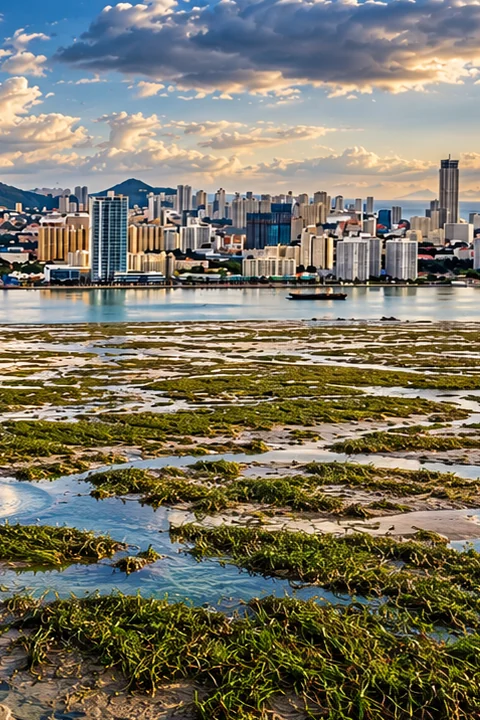
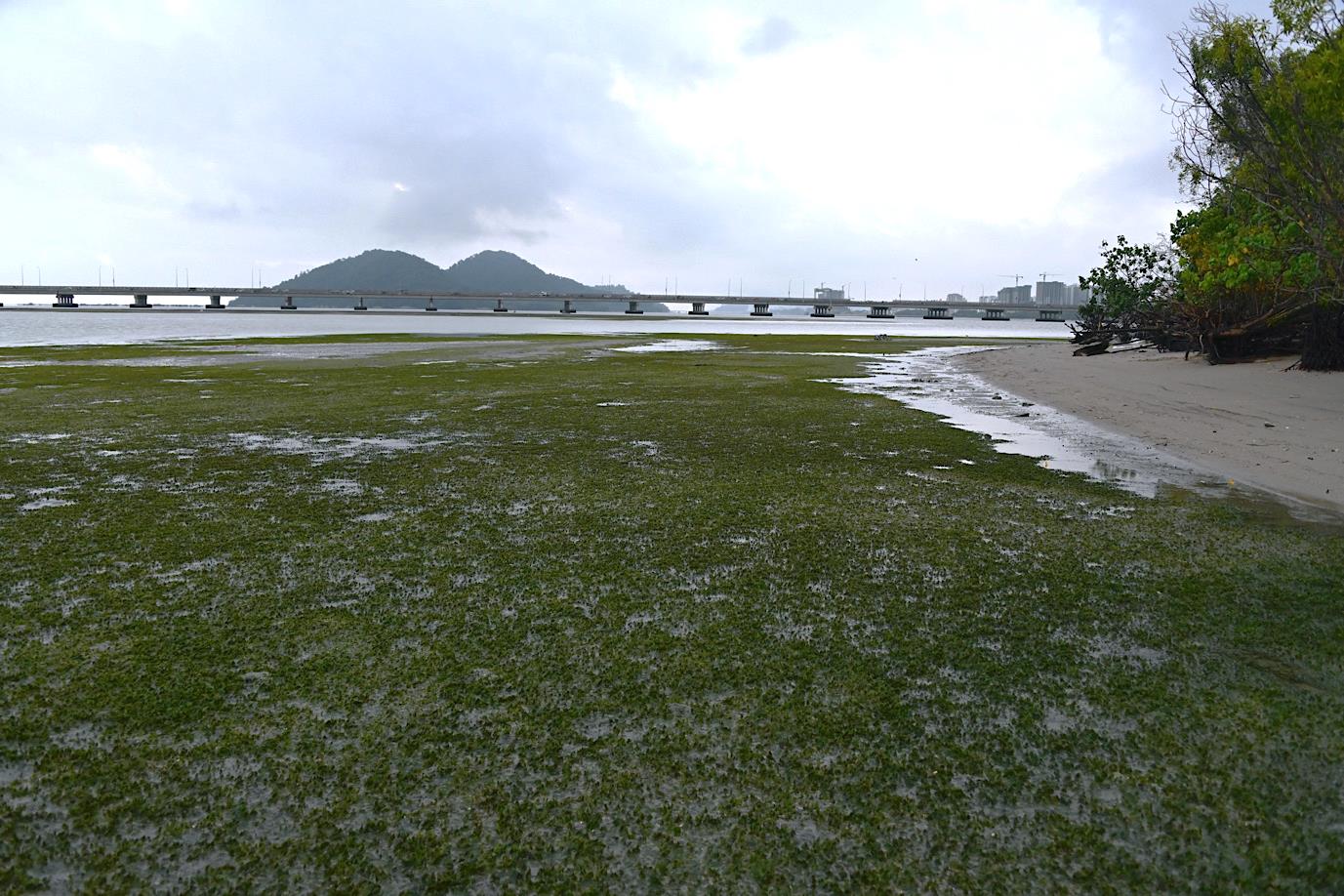
The ecological services of this ecosystem go beyond biodiversity. Seagrasses trap sediment, stabilise the seabed and improve water clarity. During the 2004 Indian Ocean tsunami, the seagrass meadows here helped buffer Penang’s coast by reducing wave energy.
In her 9 April 2025 letter, Prof. Tan describes the meadow’s sediment, water-quality and coastal-protection services. Her account of the 2004 tsunami is an attributed retrospective assessment; the letter does not quantify wave reduction at Middle Bank.
Tan, A. S. H. (2025, April 9). Conservation of Middle Bank Marine Sanctuary [Letter to the editor]. The Star.
AN ECOSYSTEM, STEP BY STEP
Choose a step to explore the process. This is an educational illustration, not a forecast or calibrated hydrodynamic model.
Tides and coastal circulation move water through shallow and deeper habitats. Conditions vary across space and time.
To measure local water movement, researchers need field measurements and bathymetry: the depth and shape of the seabed.
Moving water can carry mud and sand, let them settle, or stir settled particles back into the water (resuspension). Seagrass leaves and roots affect these processes.
Plants can slow moving water and help particles settle. The amount of wave-energy reduction depends on water depth, plant height and density, and the incoming waves; results from another coast cannot simply be applied here.
Seagrasses need light for photosynthesis. Water clarity and sediment disturbance influence the light available at the seabed.
Photosynthesis is how plants use light to make food. Explaining this process does not identify which activity caused a particular local change.
Vegetation, sediment and surrounding water support interlinked habitats. Protecting one patch requires attention to the wider system.
Fish and other animals can move between habitats. Repeated local observations are needed to show how habitats are connected and whether their condition is changing.
BLUE CARBON, CAREFULLY EXPLAINED
Seagrass ecosystems can hold carbon in vegetation and sediment. Assessing their climate role requires attention to carbon sources, accumulation, disturbance and net greenhouse-gas effects.
The quantity present in a defined area and sediment depth at a given time.
The change or burial measured over time, using appropriate methods.
A net climate benefit that requires more than a measurement of total sediment carbon.
No whole-sanctuary carbon total, annual offset claim or forest-equivalent calculator is presented here.
Useful terms